
The Hidden Struggles of OCD: Abbey’s Story of Hope and Healing
Reading Time: 6 minutesAbbey M., a Newport Institute alum, traces her struggles with obsessive-compulsive disorder back to age 11. That’s when she started repeatedly washing her hands and using hand sanitizer. Abbey was severely bullied in school, and performing these cleansing rituals seemed to calm her anxiety.
Then the compulsions began taking on different forms. Handwashing soon turned to repetitive checking behaviors, like constantly making sure the faucet was turned off. Then Abbey tried counting to 25 to ease her anxiety. Before long, even that wasn’t enough—she needed to repeat the pattern multiple times consecutively. Eventually, Abbey entered an endless loop of compulsions that she says kept her from moving forward in her day—and in her life.
“The whole thing with OCD is you’re triggered by something, and then you do a compulsion and that makes your anxiety go down,” she says. “Well, that continues a loop that is counterproductive. What you think are small compulsions become larger and larger.”
Questions?
We know that reaching out can be difficult. Our compassionate team of experts is here to help.
Join Us for an Alumni Webinar
Reserve your spot for an insightful and moving conversation with Newport alumni, on their experiences of facing and overcoming anxiety and OCD.
A Misunderstood Disorder
It’s not uncommon for people with obsessive-compulsive disorder (OCD) to feel misunderstood and alone in their battle. Many people think that OCD is just a personality quirk, or that it’s about being neat and organized. This downplays the seriousness and severity of the disorder, which affects around 1 in 40 adults.
The truth is, living with OCD impacts every aspect of a person’s life, from relationships to school, career, and day-to-day activities. People with OCD experience obsessions—persistent thoughts, impulses, or images that cause distress. Then, in an attempt to suppress the thoughts and reduce the distress, they engage in physical or mental compulsions, like Abbey’s handwashing, which is associated with contamination OCD, a subtype of the disorder.
Abbey’s ‘Downward Spiral’
When Abbey reached high school, her OCD began to take on a different, scarier form. She started having symptoms consistent with harm OCD, an OCD subtype characterized by an irrational fear of hurting oneself or others. People with harm OCD suffer with ego-dystonic thoughts—thoughts that are inconsistent with their beliefs, values, and sense of self. Having harm OCD is not associated with committing violent acts, only with the fear of doing so.
Abbey carried this burden throughout college and into her teaching career. Eventually, it became too much, and her mental health struggles forced her to leave her job.
“That is what ended up causing my downward spiral. The intrusive thoughts I was having made me question whether I was a good person,” she recalls. “And that’s when the depression started. It was at that point I knew I needed treatment.”
According to the International OCD Foundation, 25 to 50 percent of individuals with OCD will also experience depression at some point in their lives. Studies also suggest that more than half of people with OCD meet the lifetime criteria for major depressive disorder.
When I realized that I needed to be the one to take charge of my mental health, that's when things started turning around.
Abbey M.
Newport Institute Alum
The Turning Point
Abbey’s parents found a mental health inpatient program and helped her get admitted. This was the beginning of a long road consisting of multiple stays at different residential locations and Partial Hospitalization Programs. But nothing seemed to stick, Abbey said, in part, because these programs were not OCD-specific and because she didn’t have the right mindset at the time.
“I had been told by therapists, psychiatrists, and my parents that there was not going to be a be a magic pill out there to fix me,” she said. “I had to be ready, and I had to be the one to put the work in. And at that time, I wasn’t ready to hear that.”
“I had to sit with my feelings for a while,” she continued. “It wasn’t easy. But then I realized, I haven’t tried being the one. I’ve been letting other people try for me.”
Taking Charge of Her Mental Health
With a renewed mindset and a determination to get her OCD under control, Abbey was ready to find a new treatment program—all on her own.
“When I realized that I needed to be the one to take charge of my mental health, that’s when things started turning around,” she said. “Before Newport, I hadn’t found a residential setting that specialized in OCD. When they told me they had space in their program in Virginia, I packed my bags. And it was the best decision I’ve made.”
When Abbey arrived at Newport’s OCD-specific residential program in Leesburg, Virginia, she was relieved to find a quaint, home-like environment and not the sterile hospital setting she’d experienced at other treatment programs. There were comfortable spaces to gather for meals and downtime, and even more important, she could connect with others who understood the daily struggles of OCD.


The Newport Difference
What made Newport different from the other programs Abbey had tried? She says the main difference was the expert, compassionate support she received from the clinicians and staff. OCD treatment includes regular sessions of Exposure and Response Prevention (ERP) therapy, the gold-standard modality for OCD. During sessions, therapists gradually expose patients to the thoughts, situations, or objects that trigger their obsessions. Repeated exposures in a controlled and supportive environment help patients learn that their anxiety will diminish over time without the need for compulsive responses.
Abbey explained that, prior to Newport, she didn’t receive the guided support she needed to bring her anxiety back down to a comfortable level during exposure therapy. She would be left alone during exposures, something she said she wasn’t ready for. But at Newport, the staff—from clinicians to care coordinators—were always there throughout the process. If they sensed that Abbey was experiencing any dysregulation, they were by her side with suggestions for coping skills she could use.
The Family Connection
Though Abbey and her parents have a great relationship, they opted to take part in regular family therapy sessions as part of her treatment. The sessions helped her parents understand what harm OCD is, how it differs from the OCD stereotypes they’d heard about, and how to better support her. For example, they learned that hiding objects (like knives or scissors) that triggered Abbey’s fear and anxiety, something they did often, is counterproductive and only perpetuates the fear.
The family is also learning tools for effective communication, Abbey said. Now that she has completed residential treatment, she and her parents have weekly family meetings to set goals, share challenges, and celebrate victories.
Moving Forward with OCD
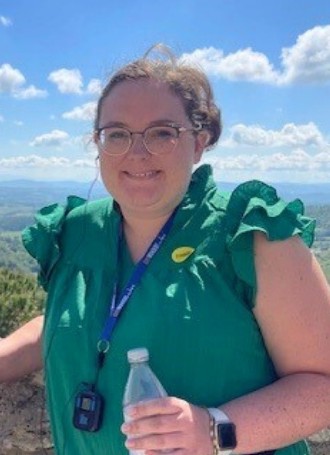
Abbey says she’s learned a lot about herself during her time in treatment and along her path to healing. She has more confidence in making decisions about her life, just like the one she made to come to Newport.
“I had lost a lot of trust in myself,” she said. “And it was a long journey to gain that back. But at Newport, I got there.”
Abbey is in a part-time role as she explores her next career path. She’s using the skills she learned in therapy to respond effectively to anything that might trigger her OCD throughout the day. Abbey knows that managing her OCD is a lifetime commitment, but now, thanks to therapy, she has the coping strategies and self-understanding to do so effectively.
“It’s going to always be a battle that I have to face, but it doesn’t feel like a war anymore,” she said.
Becoming an Advocate
Abbey is proud of how far she’s come and wants other young adults to know that there is hope through treatment. She continues to receive support through Newport’s virtual Intensive Outpatient Program. She is also an active member of Newport’s alumni program, which offers numerous online and in-person ways to connect with others who have gone through treatment.
Reflecting on her time at Newport, Abbey has some words of advice for anyone considering residential or outpatient care.
“Your journey is what you make of it. If you go to treatment and have a bad attitude, you won’t get a whole lot out of it. But if you go with a completely open mind, and you make that leap, it’s completely worth it.”
Specialized OCD Treatment at Newport
If you or a loved one is battling the devastating effects of OCD, Newport Institute can help. Contact us today to learn more about our ODC-specific programming for young adults ages 18–35.
We also provide OCD-specific treatment for adolescents through our teen program, Newport Academy; find out more here.